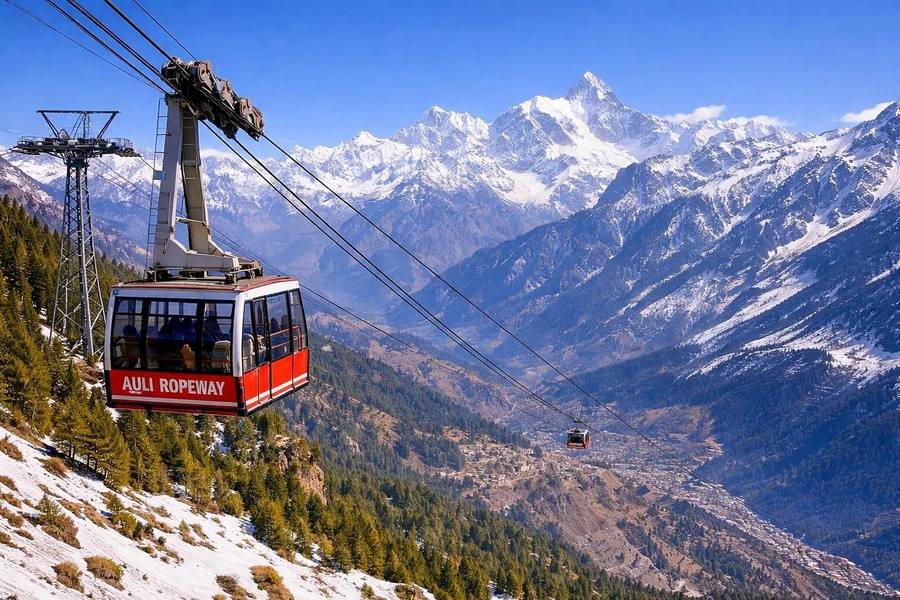
 6 Days · 5 NightsThe Alpine Sojourn
Mussoorie & Auli Highlands
Cloud-level promenades and snowfield picnics across Uttarakhand's finest hills.
From₹27,999
View PackageA world-heritage meadow that blooms only in the monsoon.
The Valley of Flowers is a UNESCO World Heritage Site and, for about eight weeks a year, one of the most improbable places on earth. It is a glacial valley roughly eight kilometres long at around 3,600 metres, and for the duration of the monsoon it fills with over 500 species of alpine flowers in overlapping waves — blue Himalayan poppies, cobra lilies, anemones, primulas, marsh marigolds, and the Brahma Kamal that opens after dark. The rest of the year it lies under snow. It was mapped by the British mountaineer Frank Smythe in 1931 after he stumbled into it while descending from Kamet, and his account is still the best thing written about it.
Getting there takes commitment, which is part of why it stays as pristine as it does. From Haridwar it is a ten-hour drive to Govindghat, then a thirteen-kilometre walk or pony ride to Ghangaria, the small base village where everyone stays. From Ghangaria it is a further three to four kilometres and about 500 metres of climb into the valley proper, which you must enter and leave the same day — no camping is permitted inside the park. Realistically the round trip from Ghangaria is six to eight hours if you walk slowly and stop constantly for photographs, which everybody does.
Most travellers pair the valley with Hemkund Sahib, which shares the same base. That is a much harder six-kilometre climb from Ghangaria to a glacial lake at 4,300 metres, where a Sikh gurdwara stands beside water so cold that the ritual dip is a genuine act of faith, ringed by seven peaks. The langar at the top serves hot tea and khichdi to everyone who makes it, and the atmosphere on that shore is something guests remember long after the flowers.
The window is narrow and worth planning around: the park opens on the first of June and closes on the fourth of October, but the real bloom runs from mid-July through late August, peaking in the first half of August. That is also peak monsoon, so expect rain, leeches on the lower trail and slippery rock, and pack accordingly — we send a kit list well in advance. We handle the national park permits, the Ghangaria stay, ponies or porters where wanted, and a guide who knows which side valley is flowering that particular week.
A UNESCO meadow that blooms with 300+ alpine species each monsoon.
A sacred glacial-lake gurudwara at 4,633 m, often paired with the valley.
The glacial stream that winds through the flowering valley.
The cosy base village where the twin treks begin.
The gateway town on the Alaknanda, with its landmark gurudwara.
6 Days · 5 NightsThe Alpine SojournCloud-level promenades and snowfield picnics across Uttarakhand's finest hills.
A moderate 3–4 km from Ghangaria into the valley; we set an easy pace with guides.
Yes — a national-park permit, which we arrange for you in advance.
Our concierge will craft a private itinerary around your dates, group and pace.
No call centre, no scripts. You reach the same Haridwar office that dispatches the car — any hour, any day, in Hindi or English.